
Wellness podcaster and neuroscientist Andrew Huberman is working on a book described as a “guide to improving brain function, enhancing mood and energy, optimizing bodily health and physical performance”. It’s called Protocols: An Operating Manual for the Human Body. If you listen to his podcast, as I have from time to time, you are likely familiar with many of these protocols. Look at the sun first thing in the morning. Regulate your circadian rhythms and breathe in a specific pattern to improve sleep, concentration, and mood. The protocols themselves are useful, and Huberman does a great job of simplifying complex physiological concepts.
But taken to a rigid extreme, they seem almost ritualistic–even religious. And that’s because, like many modern wellness protocols, they are. And the growing popularity of the wellness movement is due in no small part to a market hungry for ritualistic practices that provide a sense of control in an increasingly chaotic world.
But can the wellness movement save our souls?
The Growing Wellness Movement
Robert F. Kennedy and the MAHA moms may have brought the wellness movement to a new level of visibility, but it’s been around for a while. In my experience, wellness is the part of a Venn diagram where right-wing patriots and liberal hippies intersect. It’s been on the rise since the late ’60s and is largely based on Halbert Dunn’s idea that our approach to health should focus on maximizing one’s potential rather than solely the absence of disease. The graphic below highlights how the use of words like holistic and wellness has increasingly been used in books since that time, with a recent peak (chart made using Google’s Ngram viewer).
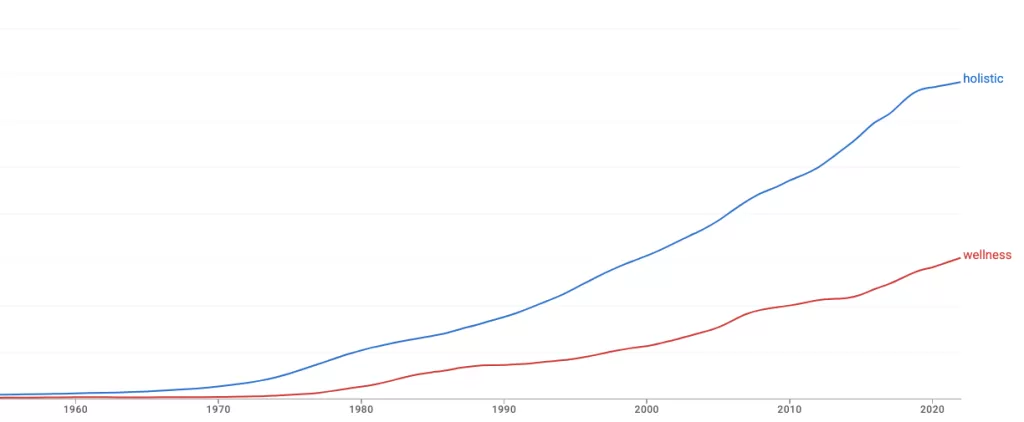
Several recent factors have enabled the movement’s institutionalization into mainstream culture. Mistrust of the medical industry and traditional science was growing long before COVID, but COVID certainly fueled the flame. And those concerns have a powerful sound system. Social media offers new platforms to voice alternative perspectives at an unprecedented level. Wellness influencers who might have been considered fringe in the past now have a highly visible, albeit unvetted, pulpit to evangelize a rapidly expanding congregation.
Structural factors like social media and pandemics certainly helped accelerate the pace at which the wellness movement coalesced into the mainstream. But that doesn’t fully account for its growth. The algorithm feeds people what they already want. The assurance of control and cleansing guaranteed by Huberman’s protocols offers more than just good wisdom for functional health. It offers a sense of order and, on some level, purification. It offers the certainty we all crave in these very uncertain times.
And that assurance has come at a time when traditional sources of moral authority have lost their credibility. Americans may have lost confidence in religious leaders and rejected moral absolutism. The subservience of self necessary for communal spiritual experiences and related accountability is incompatible with the prevailing “you do you” mindset. But that doesn’t mean we’ve lost our desire for the structure religion provides.
The Ritualistic Nature of Wellness Movement
In his fascinating book Ritual, anthropologist Dimitris Xygalatas highlights the importance of rituals in both religious and secular contexts as a tool for reducing anxiety and enhancing social cohesion. According to Xygalatas, rituals have three components: rigidity (actions must be done in a specific way), repetition (the action must be consistently repeated), and redundancy (much of what is done has no practical utility). Together, these three provide predictive actions that help individuals cope with uncertainty and regulate anxiety. They do so by introducing a level of control and predictability in otherwise stressful circumstances.
If aliens showed up and observed modern society, they might not be able to discern the difference between the animal skins worn by shamanic priests to fend off disease and the weighted vests the middle-aged women in your suburban neighborhood wear to fend off the impact of aging on their bones. (I don’t judge. I, too, am a middle-aged woman with a weighted vest.) Staring at the sun immediately after waking up might not look too different from ancient sun gazing rituals. Applying sage oil to our feet before bedtime seems closer to a religious ceremony than an evidence-based protocol for reducing mental fatigue.
According to Xygalatas, ritualization is not only a natural response to anxiety, it can also be a psychologically productive response. Have you ever rage-cleaned before hosting the extended family for a holiday gathering? There’s scientific evidence that the act of cleaning diminishes the physiological symptoms of stress. What about those rituals athletes perform before shooting a free throw? Remove the rituals and their stats drop.
That doesn’t mean there’s a causal link between these rituals and their outcomes. Just like free-throw rituals, the medical evidence behind many wellness claims is lacking. Nonetheless, believers hold up their subjective experiences as a different form of proof. And those subjective experiences aren’t insignificant. These ritualistic practices offer devotees a natural opportunity to exert control over their pervasive sense of uncertainty. And there’s a premium on certainty in an increasingly chaotic world.
Spiritual Danger of Wellness
If the wellness protocol isn’t inherently dangerous, is there any harm in following its protocols? Especially if it might reduce anxiety. After all, morning sunlight can be good for the body. And it’s a good idea to optimize sleep.
But doing so will only save your body–not your soul.
There’s a spiritual danger in substituting wellness rituals for authentic spirituality. By definition, spirituality involves ceding the control and command of our lives, actions, and outcomes to a force that surpasses the material and mental management so instinctive to human nature. Spiritual salvation entails a looser grip on the things we can control rather than a tighter one.
Our modern propensity for wellness rituals is more indicative of a disease than a cure. A thirst for order in chaos. Rituals might improve your sleep, enhance your mental performance, or strengthen your fitness. For those reasons, I’ll keep going on my morning walks. But I recognize its limitations.
But rituals–religious or physical–can’t provide supernatural peace in the midst of a world spiraling out of control. All they can promise is a tighter grip on the things we can control. And that’s exactly what the wellness movement offers.
Who needs faith for the unseen when you have the assurance offered by a strict protocol? Feeling impure? Try a detox. Salvation comes without ceding our individual sovereignty to a higher power or decentralizing our self. Our faith is focused on the precision of our own actions and typically measured against our individualized physiological metrics. That spares us the cost of exercising faith in something that can’t be measured or optimized.
The control it permits–even if misguided–might calm you. It might bring order and even a sense of purification. But it has no utility beyond that which can be governed. Wellness can’t supply the peace that transcends the virulent nature of our times. Tightly managed protocols won’t elevate us beyond the limitations of our humanity.
For that, you’ll need a spiritual cure.